Under the Storyset license, illustrations are free for commercial use, but the free tier requires visible attribution (a credit with a link) and applies daily download limits. A Freepik Premium subscription removes both the credit requirement and the caps. Storyset is owned by Freepik, so its license runs through Freepik's terms, which is why the free version has strings that a subscription cuts. If you can show a credit, Storyset is one of the most capable free illustration tools; if you cannot, the free tier gets awkward fast.
Is Storyset free?
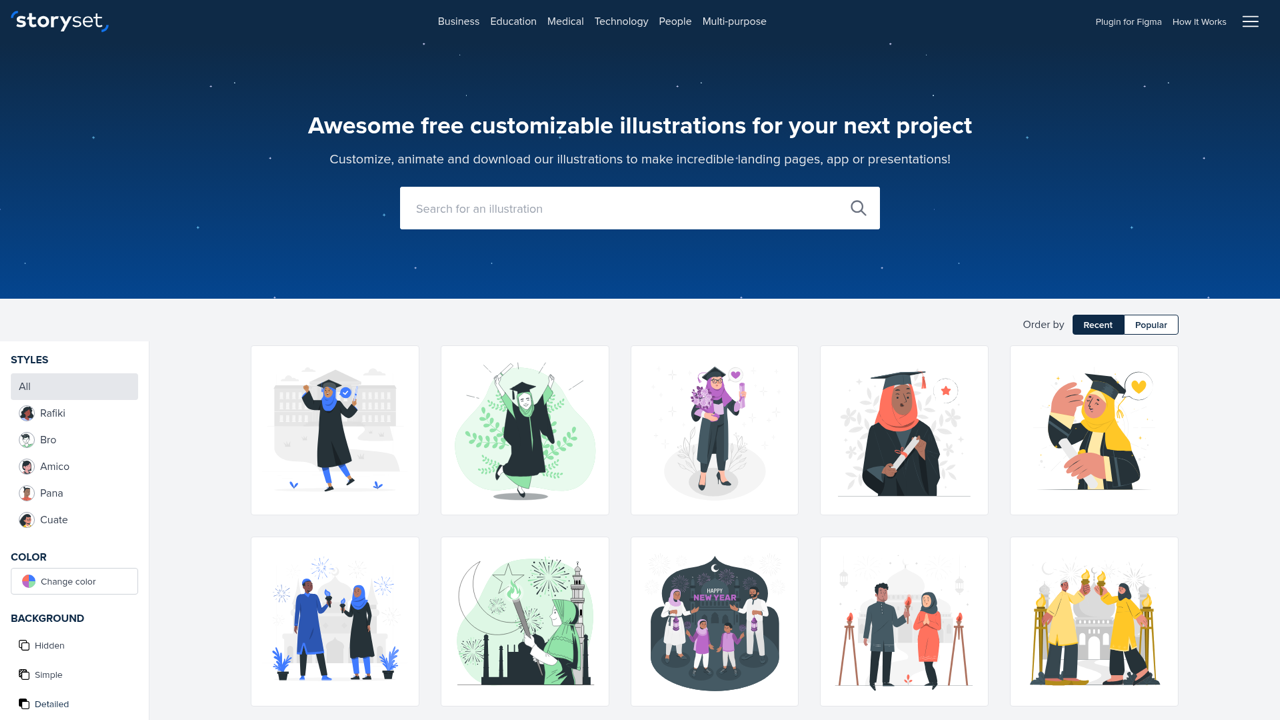
Yes, with conditions. Every illustration on Storyset can be downloaded for free, and the online editor that recolors and animates scenes is free to use as well. What makes Storyset "free with strings" rather than "free" is two limits on the free tier: an attribution requirement and daily download caps. Neither is unreasonable, but both are rarely stated plainly before you have already built a design around a Storyset scene.
This is the Freepik model. The free tier is a genuine, usable product and also a funnel into the Freepik Premium subscription, which is where the strings come off.
Do you need to credit Storyset?
On the free tier, yes. Freepik's license requires a visible credit with a link back to Storyset in the project where you use the illustration. Where that credit goes depends on the medium:
- On a website, a line in the footer is the usual place ("Illustrations by Storyset" with a link).
- In a video or presentation, the credit belongs in the description or on a closing slide.
- In client deliverables, it tends to be a hard sell, because clients rarely want an outside credit on their own site.
- In a native mobile app, there is often no natural place for it at all, which is where the requirement becomes a real blocker.
Premium subscribers do not need to attribute. So the practical question is not "is Storyset free" but "can I show a credit where I am using this." If the answer is no, you are really choosing between a subscription and a different library.
What a correct Storyset credit looks like
Freepik accepts a simple credit as long as it is visible and links back. The standard form is a line that reads "Illustrations by Storyset" with the word Storyset linked to storyset.com, placed somewhere a viewer can actually find it. A few rules keep it valid:
- The credit must sit on the same project or page where the illustration appears, not on a separate credits page that nobody visits.
- The link has to be live and point to Storyset or Freepik, not a dead or redirected URL.
- One credit can cover multiple Storyset illustrations used in the same project, so you do not need a separate line for every image.
- The requirement covers every export format, including the animated SVG, Lottie, GIF, and video versions, not just the static files. Motion is the part designers most want to reuse and the easiest place to forget a credit.
- Removing or hiding the credit later, once the project is public, puts you out of compliance even if it was there at launch.
Get the credit right once and the free tier is genuinely usable. The trouble only starts when there is nowhere the credit can legitimately go.
Storyset commercial use: what is allowed and what is not
Commercial use is allowed under Freepik's license, as long as the attribution requirement is met on the free tier. That covers products, marketing, client work, and paid content. There are, however, firm limits on what you can do with the artwork itself:
- You cannot resell or redistribute the illustrations on their own.
- You cannot bundle them into a stock product, template, or asset pack.
- You cannot use them in a trademark or logo.
These restrictions are standard for the category and unlikely to affect normal design work. The friction with Storyset is almost never these limits; it is the attribution requirement in places where a credit does not fit.
Daily download limits in practice
The second string on the free tier is a daily download cap. Freepik does not publish an exact number, and it can change over time, but the practical effect is consistent: heavy use in a single session eventually hits a wall. For occasional work, grabbing a scene or two for a page, you will never notice it. Mid-project, when you are iterating on a flow and exporting variation after variation, the cap can stop you at the worst moment and reset only the next day.
If your workflow involves pulling many assets at once, this alone is a reason to consider Premium, which lifts the cap entirely. It is a smaller issue than attribution for most teams, but it is the other half of why the free tier is "free with strings" rather than simply free. Plan around it by downloading the finals you need in one pass rather than treating Storyset as an unlimited well you can dip into all day.
Free tier vs Freepik Premium
The difference between the two tiers is simple and comes down to the two strings on the free plan:
| Free tier | Freepik Premium | |
|---|---|---|
| Download illustrations | Yes | Yes |
| Online editor and animation | Yes | Yes |
| Attribution required | Yes | No |
| Daily download caps | Yes | No |
| Cost | Free | Paid subscription |
If you use Storyset occasionally and can credit it, the free tier is genuinely good and the caps rarely bite. If you use it heavily, ship client work, or build native apps, the subscription exists to remove exactly the two problems that make the free tier awkward. Budget for it the same way you would any other design tool, and weigh it against libraries that ask for neither a credit nor a fee.
Storyset attribution in client work and apps
This is where most teams get caught. A Storyset scene looks perfect in a mockup, gets approved, and then the attribution requirement surfaces at ship time, when there is nowhere clean to put the credit. Two ways out:
- Subscribe to Freepik Premium and drop the credit requirement entirely. This is the right call if Storyset's editor and multi-style range are central to your workflow.
- Use a no-attribution library instead for the pieces that will live in credit-hostile places. unDraw and Open Peeps are both genuinely free with no credit required, so they slot into apps and client sites without a footer line.
The mistake to avoid is designing around free Storyset and discovering the string only at the end. Decide up front whether a credit is showable, and pick the source accordingly.
Storyset license vs no-attribution alternatives
If the attribution requirement is the sticking point, here is how Storyset compares to the popular libraries that ask for no credit:
| Library | Attribution | Editor / animation | Style range | License type |
|---|---|---|---|---|
| Storyset | Required on free tier | Strong (recolor, animate) | Five styles | Freepik |
| unDraw | Not required | Accent-color only | One style | Custom |
| Open Peeps | Not required | Mix-and-match people | One style (people) | CC0 |
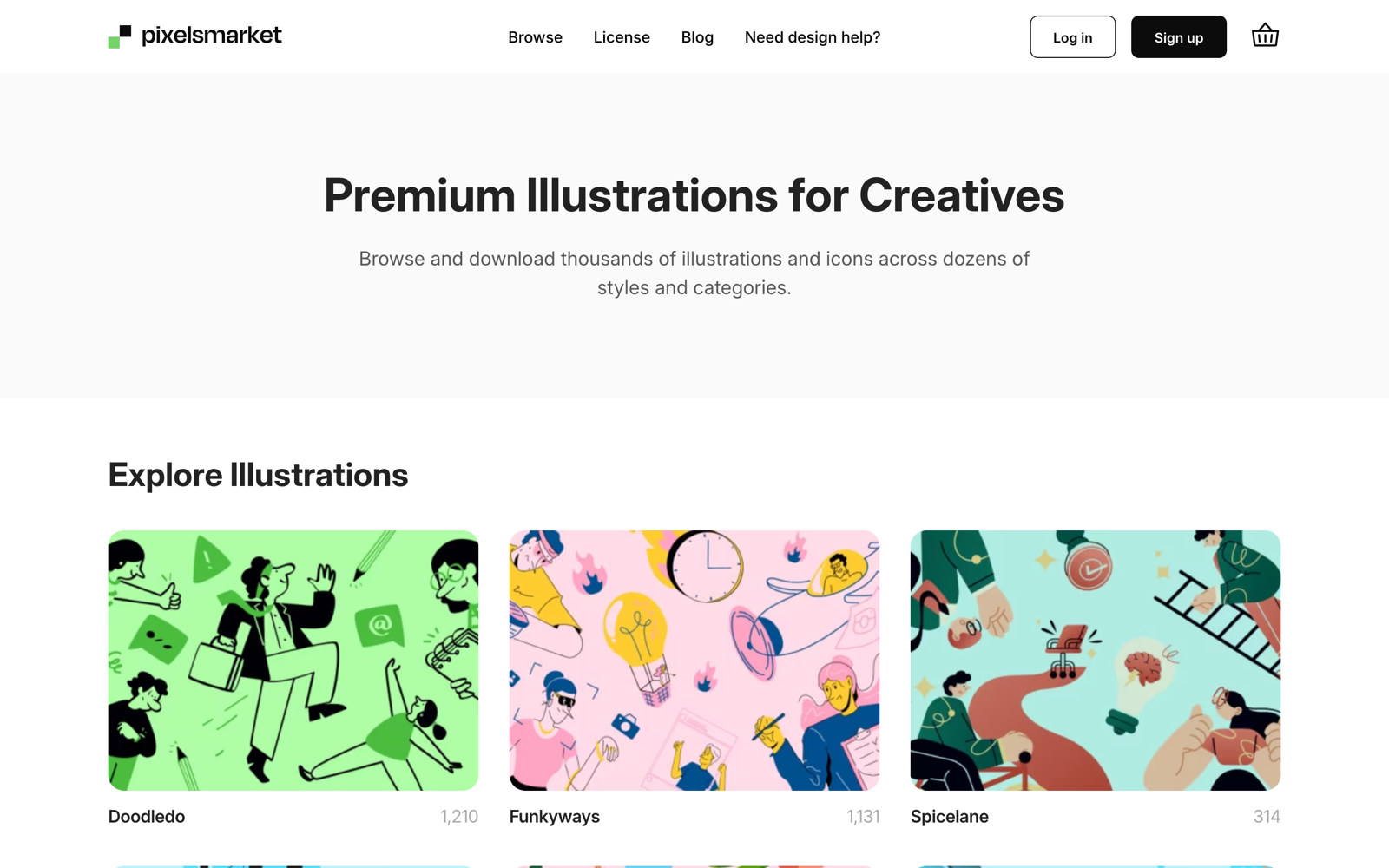
| Pixels Market | Not required (PNG) | Recolor in browser | Many styles | Custom |
Storyset wins on editing and motion; the others win on the license. unDraw is the closest free swap for general scenes, and its terms are covered in the unDraw license guide. If you want more than one style without an attribution requirement, a multi-style library like Pixels Market covers several looks under a single license. For the full feature comparison, see our Storyset review and alternatives.
Is Storyset worth it?
Storyset is worth it when its strengths line up with your constraints. The free editor and one-click animation are genuinely unmatched among free tools, so if you can credit the source, or you are happy to subscribe, few libraries give you more. The subscription is easy to justify for a team that leans on Storyset daily.
It is the wrong fit when you need illustrations for credit-hostile places, like client sites and native apps, and do not want to pay to remove the requirement. In that case, start with a no-attribution library and keep Storyset for the projects where a footer credit is fine. A common setup is to run both: Storyset with a subscription for anything that needs its editor or animation, and a free no-credit source for the routine scenes where paying and crediting would both be overkill. Either way, browse the free illustrations or the curated collections at Pixels Market if you want a no-attribution option across several styles, and read the full Storyset review before you commit.